A living room’s lighting does more than illuminate: it sets the mood, anchors the décor, and creates a focal point that draws the eye upward. Modern chandeliers have evolved far beyond the ornate crystal fixtures of decades past. Today’s designs range from sleek minimalist pendants to bold geometric statements, offering something for every aesthetic. Whether you’re renovating from scratch or refreshing tired overhead lighting, a well-chosen modern chandelier can completely transform how your living room feels and functions. The key is understanding which style aligns with your space and how to install it properly.
Table of Contents
ToggleKey Takeaways
- Modern chandeliers for living rooms serve as both functional light sources and statement art pieces that establish visual balance, especially in spaces with high or vaulted ceilings.
- Contemporary chandelier styles range from minimalist and mid-century modern designs to industrial and geometric statements, each aligning with different aesthetic preferences and interior design themes.
- Proper installation requires three critical measurements: ceiling height (minimum 84 inches clearance), room size (fixture width roughly one-third of room width), and light output of 2,000–3,000 lumens with dimmers for ambiance control.
- LED bulbs have made modern chandeliers more practical and cost-effective, lasting 25,000+ hours and requiring minimal maintenance beyond monthly dusting and occasional deep cleaning.
- If electrical work feels uncertain, hiring a licensed electrician ensures safety and compliance with local codes, while the investment protects your home and provides peace of mind.
Why Modern Chandeliers Matter for Your Living Room
A chandelier isn’t just another light fixture, it’s the crown of your living room. Unlike a recessed can light or a simple flush mount, a modern chandelier serves as both function and art. It establishes visual balance in the room, especially in spaces with high or vaulted ceilings where other fixtures would disappear.
Lighting affects how people move through and linger in your space. Warm, dimmer chandeliers encourage relaxation and conversation: cooler, brighter designs energize the room for entertaining. A chandelier also lets you layer light strategically, combining it with wall lights for living rooms to create zones of different brightness and ambiance.
Modern chandeliers are also practical. Bulbs have shifted toward LED, which means lower electricity costs and less frequent replacements. Today’s designs downsize the footprint of older fixtures, making them accessible even in moderately-sized living rooms, not just grand entrances.
Contemporary Chandelier Styles to Consider
Modern chandelier design splits into several clear directions. Understanding each helps narrow your choices before measuring and shopping.
Minimalist and Mid-Century Modern Designs
Minimalist chandeliers strip away ornamentation, focusing on clean lines and simple geometry. Think a single brass arm with a frosted globe, or a slatted wood frame with a single pendant. These designs work beautifully in living rooms paired with living room paint colors in neutral tones, grays, whites, warm beiges, or bolder, solid colors.
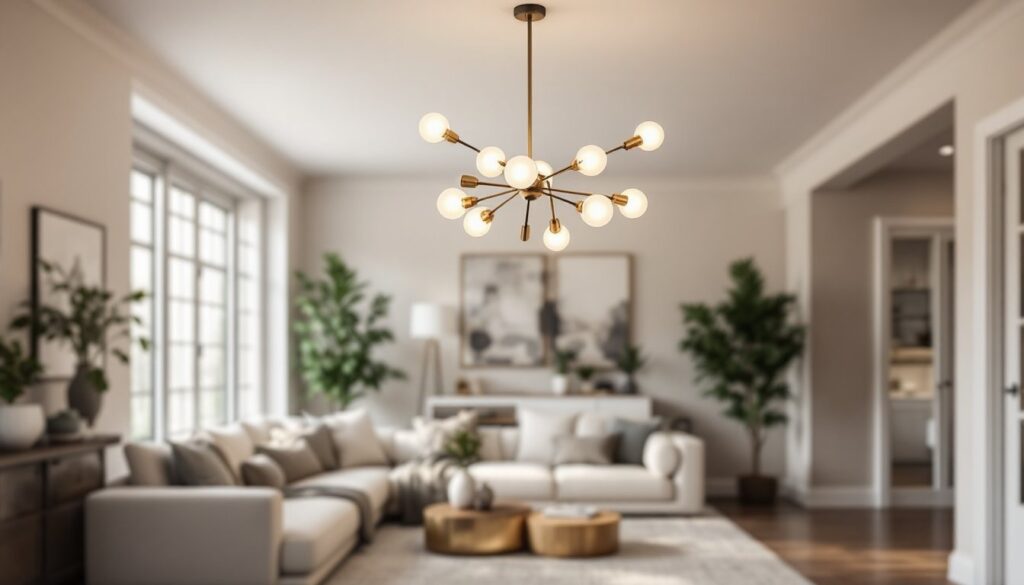
Mid-century modern chandeliers take cues from the 1950s and 1960s. They often feature tapered arms, sculptural shades, or a sunburst silhouette. Materials lean toward brass, teak, or molded plastic. These fixtures pair well with vintage furnishings and retro accent pieces, but they also ground contemporary spaces that need warmth and character.
Industrial and Geometric Chandeliers
Industrial chandeliers embrace exposed metal, blackened steel, brushed copper, or raw iron. They often feature cage-like frames, Edison-style bulbs visible to the viewer, or articulated arms. These fixtures work well in lofts and modern homes with concrete, brick, or exposed ductwork.
Geometric chandeliers use mathematical shapes: hexagons, triangles, spheres, or abstract polygons. They’re often crafted from metal frames with or without glass or fabric shades. Geometric designs feel contemporary and sculptural: they’re statement pieces that ask to be noticed. They suit living rooms with bold, curated décor and enough ceiling height to prevent visual crowding.
Designs from sources like Dwell’s modern chandelier collection demonstrate how homeowners are moving away from traditional crystal toward these forward-thinking styles.
How to Choose the Right Chandelier for Your Space
Picking the correct chandelier requires three key measurements and one honest assessment.
Ceiling height: The minimum safe distance between the lowest part of the chandelier and the floor is 84 inches, about 7 feet. If your ceiling is 8 feet, the chandelier’s drop should be no more than 20–24 inches. Higher ceilings (9+ feet) can accommodate longer fixtures, up to 36–42 inches of drop. Use this formula: ceiling height in inches minus 84, divided by 12, equals the maximum recommended fixture diameter in inches.
Room size: A chandelier’s width should be roughly one-third the width of the room it illuminates, or match the table width if it hangs over dining furniture. In a 14×16-foot living room, a 32–48-inch-wide fixture works: a smaller 12-inch chandelier would feel lost.
Light output: Modern chandeliers vary widely in brightness. Check the lumens rating, aim for 2,000–3,000 lumens for a living room depending on ambient light from windows. Pair your chandelier with dimmers to adjust ambiance: this is non-negotiable for comfort.
Style fit: Walk through your home and notice the design language already present, color palette, material finishes, and period or aesthetic references. Does smart living room technology feel at home in your space, or are you steering toward classic, analog beauty? A modern glass sphere chandelier clashes with a Victorian sofa, but a mid-century brass fixture bridges eras. Spend time on design sites like Domino and MyDomaine to build a reference board of living rooms that inspire you.
Installation and Maintenance Tips
Installation difficulty depends on your fixture and ceiling type. Drywall ceilings with existing flush mounts are straightforward: popcorn ceilings and plaster require care, and cathedral or vaulted ceilings may need a ceiling medallion or special mounting bracket.
Tools and materials you’ll need:
• Wire strippers, needle-nose pliers, wire connectors (electrical work)
• Screwdrivers (Phillips and flathead)
• Voltage tester (verify power is off before touching wires, essential for safety)
• Ladder or scaffolding, never reach from an unstable surface
• Drywall anchors or mounting hardware that came with your fixture
• Wire nuts (usually included, but handy to have extras)
Step-by-step process:
- Turn off power at the breaker and test the existing fixture wires with a voltage tester. Don’t skip this.
- Remove the old fixture by unscrewing and disconnecting the wires. Label wires with tape if they’re not already color-coded.
- Install the mounting bracket to the ceiling box per the manufacturer’s instructions. Check that it’s level and secure.
- Connect wires: Copper to copper, white to white, black to black. Use wire connectors and fold neatly into the ceiling box. Secure the neutral and hot lines with wire nuts: wrap with electrical tape if needed.
- Attach the canopy (the decorative ring that hides the ceiling box) and secure the fixture body.
- Install bulbs (usually E12 or E26 bases, verify your fixture’s specs) and attach shades or diffusers.
- Test for proper operation, then adjust hanging chains or rods if needed.
If you’re uncertain about electrical work, hire a licensed electrician. The cost is worth safety and peace of mind. Some jurisdictions require an electrical permit for ceiling fixture installation, especially if wiring is involved beyond a simple swap. Check local codes before starting.
Maintenance is minimal:
• Dust the fixture monthly with a soft cloth: use a damp cloth for stubborn grime.
• Check candles/shades for buildup and replace or clean as needed.
• Replace bulbs as they burn out, LED bulbs last 25,000+ hours, so replacements are infrequent.
• If your fixture has crystals or hanging glass elements, remove and clean them annually to keep shine sharp.
Conclusion
A modern chandelier elevates your living room from functional space to styled sanctuary. The right fixture reflects your aesthetic, suits your ceiling height and room size, and layers light with ceiling fans for living rooms or wall sconces to create comfortable, inviting ambiance. Whether you lean minimalist, industrial, or bold geometric, take time to measure, plan, and, if electrical work intimidates you, call in a professional. Your living room deserves thoughtful lighting that’s both beautiful and safe.